Scott has broken our blue water passage into several parts for blogging. Perhaps due to the fact that I have been so delayed in publishing the blog entries, I am inclined to compress the experience into one article. Forgive me as this may be a bit long and likely rambling.
The new departure weather window was now planned to depart on Tuesday, mid- morning. It was reassuring to know that we would be leaving Hampton Harbor in daylight, but unsettling to know that we would be entering and departing the gulf stream during the night and the wind and waves were going to build.
Most people see a sleek catamaran and imagine it gliding gently and effortlessly though the water. The reality is that when you are moving fast in short steep confused ocean waves then the waves have a tendency to “hull slap.” This is not a sound or feeling that you become “accustom” to, but living on catamaran now…. I accept it more quickly as a “normal” boat noise. My body no longer shudders after the boat shakes. I no longer think, “Everything is going to break apart if that happens again.”
We were hugging the shore and then turning off shore, as a large group. We were one of the last boats to leaving the dock but we were slowly passing other boats in the rally fleet. (But it’s not a race! LOL). I had been staring at the forecasted wave predictions on the Windy app for the past 24 hours.. The app often under-reports the off shore breezes and wave heights. If it says 2 meters (~6 feet) at 7 second intervals — well ….that’s going to be “unpleasant.” FYI: You do not want the ratio of feet to time interval to be anywhere near 1. Better if there is a ratio of 2 or 3, e.g., a wave height of 3 feet with 10 second interval between each wave. Whatever the predicted wave height is— double it at random timepoints because sometimes two waves combine increasing the overall height from the top to the bottom of the wave. Two days into our journey, the Captain has already mentioned in his post that the “seas were roughly 8 feet” and steady rain but not what that meant to the crew/passengers. These were large waves and confused seas. I felt that I was riding a non-stop hobby horse or bucking bronco…. but there was no getting off now. The less details here the better but you know where this is going. Scott never got sea sick, Jenna never got sea sick. I got very sea sick. It wan’t immediate. I watched the sunrise during my 6-8 AM watch and then crawled into my bunk for a “short” nap. I was shocked to see that I had slept until 11:15 AM. This was not normal. After that, I could not keep water down for about 8 hours. That day I was swearing to myself, as I was tossed to and fro in the hallway of our hull, as I dashed toward the forward head…. next time I am flying there!
I think I have been reluctant to write and publish this because well, I wanted to sugar coat this. I really did, but, I also wanted to acknowledge that it happened. Everyday cannot include dolphins and rainbows.
It was very fortunate that seasickness did not affect Scott, Mindy and Reinhart, or at least, not that I was aware. They covered for me during my 5-8 PM watch and let me rest. It was by no means a continuous nap … the harsh boat movements (and the hull slap) continually jarred me awake but after these very short periods of rest, by midnight, I was able to make a peppermint tea with honey (My ” go-to” recovery drink), nibbled on cinnamon toast at breakfast and started the 24 hour mending period. The wind speed decreased after the front passed but a decrease in wave height took several days. At least the sun had come out, and we could step outside for some fresh air.
When our blue water journey was over (in Antigua), I spoke with a few spouses that opted to fly down once their boat reached its destination. It was interesting to be reminded that change of perspective, does not relieve you of stress. The stress is just, different, mental rather than physical, because you know that the conditions are rough and that boats are reporting issues with breakages or injuries but you don’t know what is really happening on your boat with your spouse all day. I have not come to any concrete decision about future journeys. I will remind myself that with a prediction of higher wave heights, I should consider an increased dose of sea-sickness meds. Here again lies a balance, because too much medication can make me drowsy or something like that feeling of complete jet lag where you just try to push through but you don’t feel like yourself. We were far enough south on our journey that we did not experience the full severity of the storm front that many of the other boats faced.
The future forecast was the exact opposite. No wind. Again, totally different perspectives. I was thinking “Oh thank goodness” because I associate the lack of wind with a drop in wave height. The captain had a different perspective, from his point of view… the potential of having NO wind was scary or perhaps I should say “very concerning.” We had already passed the turning point to Bermuda. If we were truly without wind, that meant sitting like a cork in the middle of the Atlantic ocean (just east of the Bermuda Triangle) possibly for days, based on Chris Parker’s current weather forecast, unless we motored. We have fuel on board to run the engines….. but we did not have enough fuel to motor all the way to Antigua, even using the spare jerry cans of fuel.
Running the engines in the absence of wind is not just for motoring. It is also necessary to “charge the batteries” to keep “the electronics” up and running. Yes, we have solar on board to help charge the batteries but not enough for a full charge every day. Maybe you are thinking- why do you need electronics on a sailboat? Putting aside the fun aspects of running multiple personal computers and cell phones, to check email and weather forecasts (and keep Jenna entertained- no school work on this passage), the batteries support our two refrigerators and our freezer, which are currently packed with 3-4 weeks of food and some newly caught Mahi mahi. We use battery power to cook food on the induction burner or in the air fryer (Full disclosure: This boat has propane fuel on board for cooking on a gas burner or in the oven, so using battery power for cooking is more for convenience and for safety- cooking without an open flame on a jostling boat). Battery power is needed to make fresh water from salt water and to power our radar which tell us how close other boats are or how close a squall is. More importantly, whether or not the squalls moving toward us or whether they will pass far ahead of us, without the need to alter our course. These squalls not only contain “buckets of water” but much higher winds than the surrounding area. Those winds can rip through sails.

As the winds subsided, we discussed what we could do if the seas were flat calm. Would we go for a swim? Would you? Open, turquoise-blue ocean..absolutely no land in sight. Would you jump off and float/swim around a boat? I am not sure I could have done it. On this voyage, we never had the opportunity to truly decide. There was always a “light breeze.” We would motor sail during the day, heading as straight south as possible again trying to be as far away from the next strong weather front.
On one morning, as we motor sailed in very calm seas, Mindy shouted — “Dolphins.” This was such a wonderful sight. The large pod of dolphins played ahead of our bow wakes, swirling around each other, propelling themselves forward and jumping through. I wished they had stayed for hours but was still overjoyed to have those 10-15 minutes. Just enjoying this moment in our adventure, I chose to leave my phone/camera below.

Despite the motivational boost, I could see that the lack of a good sleep on multiple nights was taking a toll on the captain both physically and mentally. It felt good to be the calm one while he debated a potential course change toward Saint Martin. “We are going to be fine.” I said. I was certain of it. Each night around 4 PM the winds picked up enough to sail without motoring. We were making more progress than was predicted and it was a relief to hear him agree two days later that we would make it and that we should continue to Antigua.
We still needed more comic relief on board and so I gave Jenna an early gift. A pair of floppy bunny ear hat that she was pining for in September and October. The long side arms had air bladders that allowed her to control the individual bunny ears at the top of the hat.

Antigua was only two more days away. A wind shift meant that we would be pinching at a high angle into the wind (sailboats cannot sail directly into the wind) for the next 36 hours. This means more pounding to reach our destination. Yippee! Not.
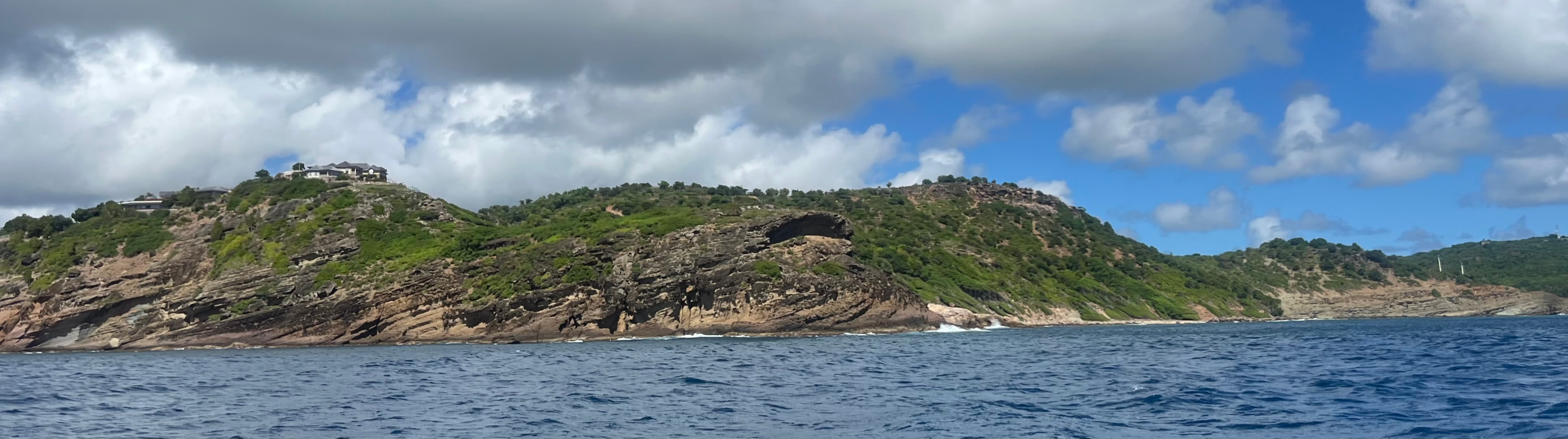
We approached Falmouth harbor, Antigua, at night. I had been dodging “ghost bouys” for the last two hours. These are virtual race buoys that still appear on the electronic charts but we think are only placed outside the harbors during the Antigua race season. They are not lit so we weren’t sure if they were present or not. At 1:30 AM, I turned the bow north, into the harbor. We had dropped the sails, and I headed toward the harbor entry. Actually…… I was headed toward the reef. Luckily, Reinhart was quick to point out that I was misreading the second red entry buoy. Could you imagine after all this time ending the trip by crashing into a shallow reef? I finally lined up the navigation lights correctly. Thanking Reinhart for speaking up. We anchored not far from another Salty Dawg boat “Carried Away” (also from Massachusetts) that arrived earlier in the evening, not much else on this west side of the harbor. Just two sailboats, or at least so I thought. After hours of sleep, I woke to see that we had anchored right near a real racing buoy. It was so small that none of us saw it at night. The 2 persons racing teams (kids and/or adults) from the local sailing school had fun passing around their small white marker buoy during their Saturday morning races, just 20 meters off our starboard hull.


We appreciate the advice and the support that we received and continue to receive from members of the Salty Dawg Sailing Association as we navigate to new places. This is a truly supportive community of sailors.
Post voyage Reinhart and Mindy sponsored our application to OCC (The Ocean Cruising Club). Members must have sailed point to point, non-stop for at least 1000 nautical miles. We received our membership approvals a few weeks ago.
We were not the fastest boat in the rally but we were able to reach Antigua a full week ahead of some of the boats that diverted to Bermuda. On this passage, we had sailed over 1700 nautical miles in 10 days and 18 hours and more adventure awaits.

Looking at the big picture, we are so happy to have experienced our journey with the Salty Dawg group.